I'm Frank McDonough, Botanical Information Consultant here at the Los Angeles County Arboretum & Botanic Garden. My job is to answer your questions about plants and just about everything related to them.
It was a beautiful day at the Arboretum today, Groundhog day, and there are some interesting plants and things to talk about.
Sinkhole in the Bauer Lawn.
A fairly impressive sinkhole has opened up on the Bauer lawn, just about where the band-shell stands during the summer concert series. It's about six to eight feet deep and at the bottom is an opening that leads to who-knows-where. One of my hobbies is cave exploring so I find this quite interesting. It is thought that this sinkhole formed when an old abandoned water well collapsed -however there is another explanation that is a bit more Indiana Jones'ish; that somewhere under the Arboretum is an old tunnel that used to lead from the racetrack, under the arboretum to who-knows-where. It's rumored that it existed to serve as a bomb shelter during World War II, and went from about where the Baldwin service entrance to the track is to the far side of the Bauer lawn. Is this a sinkhole resulting from the partial collapse of the rumored tunnel? Would it be possible to explore the tunnel if safe entry could be made into it, and if so, what kind of surprises might there be inside of it? Somebody call the History Channel, I feel a series coming on.
Sinkhole in Bauer lawn; what caused it?
Looking into the sinkhole a small passage trends westward.
Meadow-brook Section Surprises
Taking a stroll through the Meadowbrook was interesting today. For the most part it was a symphony of naked branches waiting for spring to make them decent. There were some interesting items however. First, right in the middle of the Meadowbrook's southern lawn (the Meadowbrook section has southern, northern, and western lawn areas), was what looked like a display of Liquidambar balls. They were probably collected there by Arboretum gardener Bryan Burks who was working nearby. The pile struck me as interesting so I took a picture of it at ground level.
Pile of Liquidambar seed balls on the South Meadowbrook lawn.
Magnolias Starting to Bloom -Are My Worries Valid?
Just adjacent to the Meadowbrook section is our Magnolia collection. This year is a big question mark for it. Several of the trees have bloomed out of season this early fall and the big question is; how will this (and the drought, and a moderate infestation of shot hole borers) influence this years bloom? Every year, despite all threats from the drought, insects, strange fall weather, our collection of some 40+ types of Magnolia never fail to put on a show. However this year they seem oddly late - is this perception valid? Is there a problem with them that could stymie the annual spectacular of bloom I'm so used to?
So to check out this hunch I went back into our recent photo archives and looked for pix of Magnolias blooming here from several years back. Here's what I found:
January 22, 2011
January 21, 2012
The image on the left was taken in late January 2011; It along with others from the same time show that the Magnolia collection was in full bloom by now in 2011. The image on the right is also from late January, but in 2012. So in these two years the collection was in pretty good bloom by now. However: The below images were taken February 11th, 2010 -so it's probably not time to panic just yet.
February 11th, 2010
February 11th, 2010
Keep Your Handroanthus off of my Tabebuia -Sometimes Botanists Have a Hard Time Getting it Right
This beautiful little blooming tree pictured below can be seen in full glory in the east shore of Baldwin lake. It's name here is Tabebuia impetiginosa 'Paulensis'. It is a natural variety of its origin plant that occurs in South America on grassy plains between 500 and 800 feet above sea level. The genus Tabebuia is now the genus Handroanthus. This plant is now Handroanthus avellanedae (Lorentz ex Griseb. ) Mattos var. paullensis (Toledo) Looking this particular plant up it's apparent that this is one of the most confusing genus of plants out there. For some reason taxonomists haven't done very well categorizing it. Here's a list of most of the names that his plant has had over the years:
Tabebuia avellanedae var. paulensis
Bignonia heptaphylla Vell.
Handroanthus eximius (Miq.) Mattos
Handroanthus impetiginosus var. lepidotus (Bureau) Mattos
Tabebuia avellanedae var. paulensis Toledo
Tabebuia eximia (Miq.) Sandwith
Tabebuia heptaphylla (Vell.) Toledo
Tabebuia impetiginosa var. lepidota (Bureau) Toledo
Tabebuia ipe (Mart. ex K.Schum.) Standl.
Tecoma curialis Saldanha
Tecoma eximia Miq.
Tecoma impetiginosa var. lepidota Bureau
Tecoma ipe Mart. ex K.Schum.
Handroanthus avellanedae (Lorentz ex Griseb. ) Mattos var. paullensis (Toledo) -but for how long?
Other Interesting Things Out in the Garden:
Armillaria mellea, the 'honey mushroom' growing on the infested roots of an African Acacia tree in the African section.
Beautiful gum oozing out of a Red river gum tree -if you look close you can see flecks that look like golden glitter suspended in the dark amber-colored gum.
Question: My front
lawn has been inundated by mushrooms. I
just picked 1/2 pail this morning and now I have another 1/2 pail out on the
lawn. What can I do?
Answer: Mushrooms can pop up in a lawn anytime the
conditions are right. Some come during winter rains, others during summer
humidity, and still others when there is enough moisture to precipitate dew out
on the lawn. Even lawns that are watered only once a week can produce
mushrooms. Besides in some cases producing an unsightly band of darker and then
lighter colored grass, few mushrooms contribute to lawn diseases. Many people feel that mushrooms are
unattractive and they look for a way to kill the fungus. The actual mushroom is simply the fruit of a
fungus. Killing the mushroom does not
remove or-kill-the mycelia, or fungi, causing their growth.
Still some may consider these unattractive or a nuisance.
What can be done to help lessen their occurrence? Below are some options that
can help reduce the number and occurrences of mushrooms:
1. Reduce amount of
moisture in the area: Mushrooms thrive
in moist soils, refrain from, or slow down, the amount of irrigating or water
you do to the location. This will not get rid of all the mushrooms, but can in
some cases decrease their numbers.
2. Eliminate decaying
elements that enhance the growth of mushrooms:
·Remove grass clippings after mowing, raking them
with a rake or using a bag grass catcher on the mower.
·De-thatch your
lawn. Some lawns, especially tropical grasses like Bermuda and Saint
Augustine, build up a layer of dead stems and roots that encourages mushroom
growth.
·Have tree stumps ground and removed. Leaving
tree stumps in the ground can encourage fungi that will infest other trees and
cause heart rot. Also, buried wood over two inches thick from trees that were infested
with Oak
root fungus (Armellaria mellea) can
encourage infestations of the fungus in trees whose roots come in contact with
it, as well as producing large clusters of honey colored mushrooms.
3. Increase the
amount of light in the area mushrooms grow in; this can work for some mushrooms
that do not need the sun to stimulate their fruiting, but does not work for all
mushrooms.
4. Change your brand of mulch or compost: Some mulches and
composts are very friendly to mushroom growth. If your using wood mulch make
sure that that it is composed mostly of bark –under composted wood chips are
great chow for mushroom producing fungi. If you’re using compost or amendment that
is high in under-composted steer or horse manure you are likewise treating
mushroom producing fungi to a very nutritious meal.
4. Learn to enjoy the fungi. In most cases mushroom
producing fungi is not harmful to your lawn.
6. Have your mushrooms identified. You can bring your mushrooms
to a local mycological society
meeting and have them identified. This is very good idea if you feel that
your dog or neighbor children might eat the fungi off of your lawn
.
7. Replace you lawn with ground cover and landscaping less
susceptible to mushroom growth. Low water use landscape is less likely to
harbor mushroom mycelia, and the period of mushroom production is much more
likely to be shorter than that of a lawn.
I just got married (to a wonderful woman who is, coincidentally, a master gardener) and I'm back from the honeymoon. We spent all last week in Mammoth Lakes, a beautiful mountain town and ski resort located in the eastern Sierra mountains. We were lucky as it rained the night we got there, providing some relief from the drought and bringing up some very tasty mushrooms. The first one below is Pine Bolete, the one below that and the cut mushroom ready for sauteing is Boletus edulis, also known as the Porcini in Italy and the Cepe in France. Boletus edulis is very tasty and its texture is one of the finest of any mushroom; slightly crunchy and meaty at the same time.
These were brought in by a woman who was worried about mushrooms poisoning her dog. Previously she had brought in some Conocybe mushrooms that were poisonous but may or may not have been responsible for her dog getting sick (they are known to contain toxins like the ones in the 'Death Cap' mushrooms but the chemistry of the ones in the Conocybe is such that they have to be absorbed directly into the bloodstream to be harmfull). These turned out to beCollybia fuscopurperea (also called Gymnopis villosypes) an indedible but not known to be poisonous mushroom that is classed by many as a 'LBM' (a 'little brown mushroom' so minute and inedible that its toxicity is inconsequential),
Collybia fuscopurperea
A Beetle Responsible for the Death of An Oak Tree?
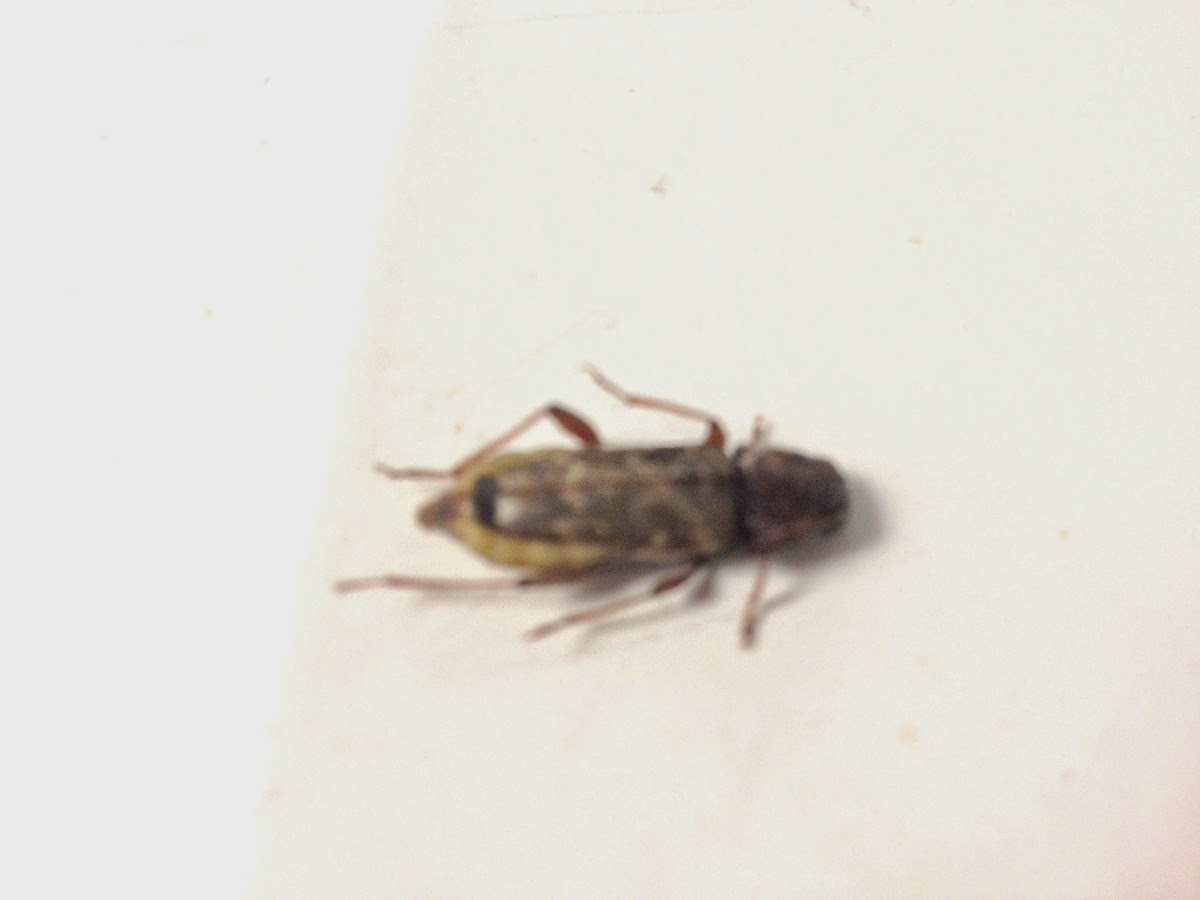
The below beetle and larvae was brought into my office to find out if it was the cause of death of live oak (Quercus agrifolia) here in Arcadia. Turns out this little bugger, called a Nautical borer, chows down on dying and dead oaks but is not responsible for the initial demise of the tree.
Nautical beetle.
Nautical beetle larvae
What is most probably the cause of the trees demise was evidenced by signs of another, more insidious beetle on an oak tree located nearby. Both branches and trunk of the tree showed the exudate and white sawdust halo of the Polyphagous Shot Hole Borer (PSHB), a fairly new pest that is decimating trees in the area.
Oak tree branch showing the soaking spot with small sawdust halo inside that is the hallmark of the Polyphagous Shot Hole Borer(PSHB).
I got the below sunflower leaf from a patron who was worried about weather these symptoms were a death sentence for the sunflower they were found on. This is the sunflower leaf miner, and like most leaf-miners it can be controlled by removing the infested leaves from the plant and cleaning the fallen ones out from underneath the plant. Chemical control is really not necessary unless you are entering the entire plant in a contest and the prize is over $10,000. One good way of keeping damage levels down (besides the above) is to keep fertilization to a minimum. High levels of nitrogen not only make the leaf soft and easy to feed on, but directly feed the leaf-miner with a nutrient that lack of otherwise limits its growth and reproduction.