Saturday, March 31, 2012

Citrus 'Worst' Disease Detected in Hacienda Heights: Can Spinach Come to the Rescue?


Huanglongbing (HLB) early symptoms on citrus leaves. 

Huanglongbing (HLB) disease of citrus, also known as citrus greening disease, has been detected in citrus pysllids and plant material the local neighborhood of Hacienda Heights. HLB is a devastating disease that leads to the death of infected trees and can lead to the destruction of the California citrus industry (it's already destroyed over 40% of the citrus trees in Florida). It looks grim but there may be a glimmer of hope represented by a gene found in spinach by Texas A&M researchers that helps fight off the disease. Unfortunately field testing has just begun on trees modified with this gene, so it may not be available for 10-20 years. Since the disease spreads rapidly (infection in the Florida trees was only first detected in 2005) that might not be enough time to save a good portion of the industry here. However, like many plant diseases it remains to be seen if the climate difference between the humid, topical climate of Florida's citrus areas and the hot, dry climate of California's citrus areas will have any effect on the spread and severity of the disease.

Associated Press Article on HLB Discovery in California and Texas A&M Spinach HLP Resistance Gene Modification

Huanglongbing (HLB) symptoms on citrus.

California Department of Food and Agriculture HLB Press Release

Tuesday, March 27, 2012

What Do Oaks and the Irish Have in Common?

 This is a Quercus agrifolia, commonly known as a coast live oak, that was brought to my attention by a North San Gabriel Valley resident. The branches of the tree had defoliated over the last several years. The lawn is a year old, but the previous owner had grown ferns under the tree before that.

This tree is a great example of an oak that might be saved. Live oaks are notorious for defoliating under stress. You might wonder, considering the verdant and luxurious lawn that can be found under this tree, what the source of this defoliating stress is? Well consider the verdant and luxurious lawn for one...and the ferns the previous owner grew underneath the oak. Both of these require lots of water compete with the tree for nutrients. But simple competition isn't the only thing. Oomycetes (in particular Phytophtora species ) organisms that are commonly called water molds, are mostly to blame. Related to the organism that caused the Irish potato famine in the mid 19th century, these destructive organisms grow, multiply and thrive in watery environments. A well irrigated lawn is one such watery environment. The film of water that coats the soil particles in moist lawns is enough to allow the swimming spores of oomycetes to infect the roots the oak tree and cause considerable damage -as well as providing a gateway to a more destructive organism; oak root fungus. It's also a good idea to check the drainage of the area around your oak to make sure that any recent construction hasn't created an impairment for the runoff of water from the area.

So what can be done? The first thing is to tear out the lawn underneath the canopy (or the area that would have been the canopy if the tree wasn't defoliated) and mulch the area with shredded bark. Then allow the trees own leaves to build up in a thick layer underneath the tree. If recent construction has impaired water runof, fix it so that water drains away from the area where the oak is planted. Then treat the area with Agrifos according to instructions (Agrifos is a type of fertilizer that has a preventative action against oomycetes). And finally adjust your watering so that you are not watering the tree; natural rainfall is usually enough to sustain the tree. However, additional watering may be necessary in situations where it is a drought year and the original water gathering root area of the tree (which can be an area up to twice the diameter of the tree's healthy canopy) is compromised.

Here is a particulalry good publication that goes over what can go wrong with oak trees.
Posted by Picasa

Saturday, March 24, 2012

Carried Away

 It's hard not to get that here when it comes to photography.
Posted by Picasa

Friday, March 23, 2012

Is This An Oak Defoliation Culprit?


Chaperral camel cricket; responsible for a naked oak tree?
  I received a picture of this guy in my email a week back from a local oak tree owner who was finding them on her now defoliated oak tree. Was this one of the infamous 'Gold Spotted Borers' whose occurrence here could spell doom for thousands of our Oak trees? Well, probably not as evidenced by this creatures large hind legs; do they look familiar? Yes, it does look like a cricket and, according to L.A. County Agricultural Commissioner's office entomologist Gavork Arakelian this is a native cricket known as the 'Southern California chaparral camel cricket'. It does eat leaves, but whether it's responsible for defoliating an entire oak tree is questionable. There are other insects that can cause defoliation including the California Oakworm, but many of those are summer pests and are inactive in the spring. Still, a closely related insect in Texas has been known to defoliate oak trees. So is this the culprit? Although I don't have enough information it is possible but not likely  because the Chaparral cricket is omnivorous, it will eat anything,  including oak leaves.
Posted by Picasa

Friday, March 16, 2012

Pad Tours


Holding tablet with picture of work-in-progress at the Madagascar spiny forest exhibit showing; can this work on a sunny day also?
  I just tested an Andriod tablet as an interpretive device today and I was pleasantly surprised. I was giving a tour to a group of about 14 college students and I used the tablet to show pictures from a powerpoint presentation on the history of the Arboretum that I had uploaded to Google web albums (AKA Picasa web albums). The students were able to see the pictures, and navigating through the album was breeze. Now today was quite cloudy so there was no problem with glare -I am looking forward to trying this out on a sunny day and see if slighlty tilting the screen down and away from the viewers will eliminate the glare (should work unless the ground is snow white).
Posted by Picasa

Friday, March 9, 2012

I Get Critters To Identify

 A client brought in this one two days ago. Several of these were found in a bathroom on the floor. At first I thought they were maggots and I wasted a lot of time searching for them, but I did learn a lot about maggots. Then I axed the maggot approach and I finally came up with what they were; case bearing moths (Tinea pellionella). Here's a video of them showing how the larvae extend out of there protective case and drag it along.

The 'cases' are shells of silk they weave for themselves that are sticky; that's why you see all the dust and dirt adhering to them. They eat wool, feathers, fur, hair, upholstered furniture, leather, fish meals, milk powders, lint, dust or paper. There is no shortage of things for them to eat in a bathroom.

Controlling them is a matter of hygiene and environment. They like to hide out and feed on dust and fibers, so keeping baseboards (where these two were found) and other hard to reach areas adjacent the floor clean is important. It also very important to dry clean your clothes if you are going to hang them up for a couple of days. The moths are attracted to dirty wool and fabric. Keeping your house relatively dry also keeps them away. UC Davis's IPM sight has more information here.
Posted by Picasa

Thursday, March 8, 2012

A Field Trip for Plant Information Volunteers.

X Chiranthofremontia lenzii, a cross between the Monkey hand flower  and Fremontodendron sp. 
Ten people, including seven plant information volunteers and their spouses, joined me for a field trip to the Ranch Santa Ana Botanic Garden yesterday. It was a gorgeous day and everybody found interesting plants that they'd never heard of before (including me). Here's a link to photos of some of the plants we saw.  We were lucky enough to have Patrick Larkin, the garden's director, speak to us before we began our tour. We were also privileged to have grounds director Joan McGuire (who worked here at the Arboretum as the herb garden curator before accepting her position at RSABG) and tour coordinator Judy Hayami (also ex of the Arboretum) meet us before the tour began.

Thursday, March 1, 2012

Field Trip To Ranch Santa Ana Botanic Gardens Wednesday March 7th @ 2pm

I hold monthly classes for all my plant information volunteers on the first Wednesday of the month at 1:30 pm. The classes are usually held in my office, are free, and are also open to members of the general public for free. I give slide presentations (last month we looked at tree damage here at the Arboretum) and go over the most interesting questions I recieve during the the last month. This month we're doing something different.

Between 1:30 and 2pm this next Wednesday (March 7th) we'll all be meeting at the entrance kiosk of the Ranch Santa Ana Botanic Garden (RSABG) in Claremont. Remember you'll be responsible for your own transportation to RSABG, and you'll also be responsible for your admisson (free if you're an Arboretum member -don't forget your card).


View Rancho Santa Ana Botanic Garden in a larger map


Admission:
$8 Adults
$6 Seniors (65+)
$6 Students w/ valid ID
$4 children aged 3-12
No charge for children under 3

If You Are An Arboretum Member You Will Receive a Free Reciprocal Admission, Don't Forget to Bring Your Arboretum Membership Card. 

How To Get Great Shots of the Arboretum

How to Process Great Shots of the Arboretum using HDR (High Dynamic Range) Software


One of the big problems photographing any outdoor scene is the huge amount of contrast you might encounter. If you expose the picture at a high ISO you get more details but your color seems washed out, expose at a low ISO and you get vast amounts of shadow that take away from the image. Now there is software that can take 'bracketed' (two or three pictures taken of the same scene; one at the recommended exposure and the other one or two a step above and/or below that value respectively) The software evens out the tones and keeps the contrast from being too high. It can also compress the tones to make them more colorful and dynamic, but not to the point where believability has to be suspended. Below is an example two photographs I used HDR on to make a single, dynamic and impactful image. 
Shot of aloe section and cactus and succulent section at recommended exposure level (Nikon D5000)


Shot of aloe section and cactus and succulent section at  1 step under recommended  exposure level. 


Composite of above images created  using HDR software. 
Right now I'm using Photomatix Pro for my HDR processing, it's about$90 and you can download a trial version (it leaves a watermark on the image when your done). 

Friday, February 24, 2012

But Wait!!!


If you're a fan of cheesy infomercials and large potentially invasive vines that attract hummingbirds and can give you a rash (albeit a fast disappearing one), then this is for you: https://www.hummingbirdvinesoffer.com/

BTW, the vine is Campsis radicans, a member of the Bignoneaceae family (the same family that brought you the Pink trumpet tree, Tabebuia impetiginosa).

Wednesday, February 22, 2012

Tabebuia's In Bloom Now

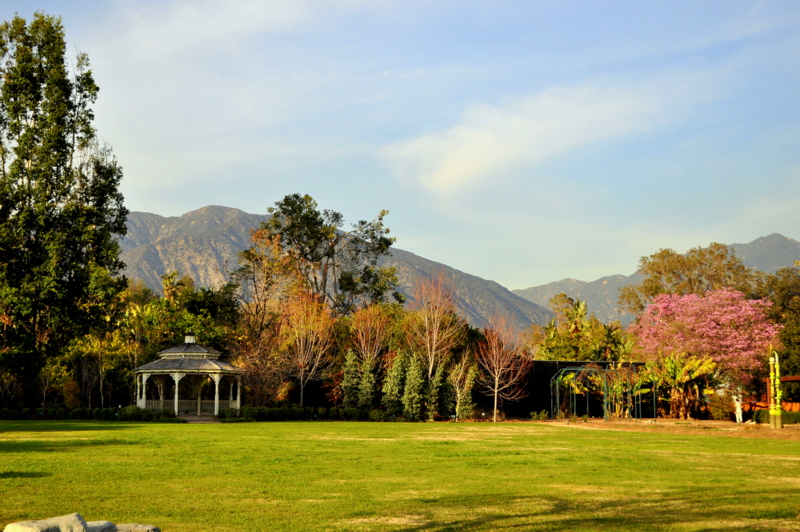
You know spring is really here when the Tabebuias start blooming. Native to South America, they do very well here as moderate growing shade trees up to 50-60 feet tall. . Most of our specimens made it through the wind, although one very early blooming tree was severely damaged. We're keeping the tree, but it's not pretty. All that's left is a stump but hopefully that will grow back sufficiently to provide us material enough to make some cuttings. Before the wind snapped it in half you could see it blooming, always several weeks before all the other Tabebuias, behind the wedding gazebo located at the north end of the event lawn. Still the view from the lawn is spectacular, and a smaller Tabebuia located next to the carnivorous plants greenhouse has taken up the slack.

Wednesday, February 15, 2012

Foot Wide Magnolia Blooms in the Herb Garden

*Magnolia x   veitchii? in bloom in the Herb Garden
Magnolia x veitchii?  being admired by staff. (l to r) Arboretum herb garden curator Theresa Rachau and Irene Chang.


 Located in the herb garden, this large flowering Magnolia is blooming right now. The monster flowers can be up to a foot across, and they have an odor much like peppermint. The identity of this beauty is a little bit of a puzzle, as it was accessioned . It has  some characteristics of Magnolia campbellii (the large bloom and pleasant odor) but was accessioned as Magnolia x veitchii, a cross made by British horticulturalist Peter Veitch between M. campbellii and M. denudata in 1907.

* At first I thought this was Magnolia campbellii var. albe 'Stybing White'; but it turns out that this Magnolia was accessioned before M. campbellii var. alba 'Strybing White''s introduction in 1962. 

Wednesday, January 25, 2012

Browse Our Magnolia Collection -Beta Testers Wanted

I've published a Google map of our Magnolia collection. Each one of the blue icons is a Magnolia in our collection, just click on it and you'll get a short description and history of each plant. It's cool, but the coolest thing is that you can load this map up on your Google Maps app on you iPhone or your Android phone and use your GPS to find out what Magnolia you're looking at in the field. Try it out if you have one of the above and let me know how it works for you.

View Flowering Magnolias at the L. A. Arboretum in a larger map

Saturday, January 21, 2012

Wild and Wooly

When I started this job 14 years ago I'd get lots of stuff in the mail. Sometimes the packages would be dripping strange fluids, emitting strange odors and containing strange life forms. These days with email and digital photography I'm mostly spared these surprises but there are still things that require a sample. The pest below is a good example of this. What you see is a citrus whitefly. Now 'citrus whitefly' is a term for any of three different species of whitefly that currently infest citrus trees.

Sample of citrus leaves with wooly whitefly infestation. 


The sample you see on the left is a lemon tree that has been infested with citrus whitefly. Notice the fuzzy white patches. These patches are the reason I needed to see this sample. When this had been originally described to me it was described as a 'fungus'.

Now of the three whiteflies that infest citrus here this one appears to be the 'wooly whitefly'.

Now if you look closer (the lower two images were taken with a magnifier) you'll notice that the 'fungus' looks more like cotton and that there are what look like scale insects surrounding the fuzzy stuff. These 'scales' are actually the immature (nymphal) stages of the whitefly. These 'nymphs' will eventually cover themselves in a cottony tuft of wax fibers (the 'wool' in the pests common name)  that the exude from their bodies. This wax serves to protect them from predators and it also repels water (that's why most contact insecticides will not control them very well).

Some methods of control that do work are:
1. Pruning the tree to increase air circulation.
2. Spraying horticultural oil solution on the tree. This has to be done during the cool time of year or else the oil spray will damage or kill the citrus tree's foliage.
3. Decreasing the amount of nitrogen that the tree receives. Instead of feeding three times a year feed just once.  If you feed citrus too frequently their sap's concentration of nitrogen goes up. Since nitrogen is the limiting factor in the growth of the pests (they've got all  the sugar they need for energy -what they need is nitrogen to form the proteins of their body tissues) if you over fertilize you're practically sending out an invitation to white flies and pests like them to infest your trees. Use organic fertilizers because their availability coincides with the availability of the natural predators that keep the white fly under control -in other words when its warm outside there are lots of predators to control the whiteflies so that is the ideal time you want fertilizer to be available to your citrus trees.  Do not use fertilizers that are immediately available to the plant like ammonium nitrate and urea (found in commonly available water soluble  fertilizers like 'Miracle-Gro').

For more information on control of this whitefly download this PDF:


Wednesday, January 18, 2012

January 17th out in the Arboretum


Flowering stalks of the King palm (Archontophoenix cunninghamiana).


Tan, pom-pom like flowers of Acacia stenophylla blooming in the Australian section.


Acacia spectabilis, the 'Glory Wattle', earns its common name. Located in the Australian section.


Acacia merinthophora's distinct arangement of stems and phyllodes (leaf-like stems) gives it its common name: the Zig zag wattle.


Friday, January 6, 2012

Back from Flu Bout; Class Rescheduled

I'm back after a wicked bout with that seemed like the flu. For all of you who missed the class yesterday I'll be holding it next Wednesday, same time same channel (1:30 to 3:00 in my office). I'll be covering Spring bulbs, local fungus (in preparation for the rainy season which is not here just yet), and of course the best of 2012's plant information questions so far.

Here's a cool link; it's the UCR Avocado variety page. The trick is to select at least two varieties that are good for your climate zone and are A and B type Avocados respectively. Having both of these flowering types can help insure a steady and abundant supply of Avocados.

Wednesday, December 28, 2011

A Rant On Liquidambars


 Our recent breezy weather is bringing out lots of concern about the safety of trees planted next to houses. I recently had an inquiry regarding one tree that should never be planted near houses or any hard-scaping for that matter...and it's not a Ficus.

Liquidambar styraciflua is a tree native to parts of the Southeast United States, Mexico and parts of Central America. It’s called a ‘Sweet Gum’ because Native Americans would chew the tree’s resin like chewing gum.  The tree is not at home here in dry Southern California. Where it's native the precipitation averages 25-35 inches of rain a year. The problem is that it is also a tree that has evolved to survive in rocky, infertile soil in its native range.  This ability to ‘tough out’ those harsh conditions makes it appear to be the perfect tree for Southern California; nothing is further from the truth. With the dry winds and the infrequent precipitation Liquidambars here are constantly under water stress.  They also have the propensity to develop very invasive and destructive roots.  But wait there’s more. Ever since 1998 when a new pest called the ‘glassy winged sharpshooter’ was introduced to California Liquidambars have been infected with a disease called ‘scorch’.  First appearing on Oleanders, this disease is a bacteria that plugs up the water conducting tissues of the plants it infects and causes the shoots furthest from roots to dry out so fast they literally ‘scorch’ where they stand.  This has gotten so bad in parts of Riverside county that it causes the trees to die back to almost 2/3 of their former height, causing them to look disfigured and leading to their removal for aesthetic reasons.

Now also consider that the  chances of damage from the wind toppling Liquidambar  trees is  probably not as great as the chances that the trees roots will damage some structure that the tree is within 10-25 feet of. 

So all this leads me to my final opinion on yours, and every other Liquidambar tree growing in Southern California. Unless your tree is at least 25 feet away from any structure it can damage with its invasive roots, and is surrounded by a lawn (which is the only way it’s going to get sufficient water to remain healthy and tolerate the effects of the scorch disease) I would remove the trees and plant something else.

Wednesday, December 21, 2011

Aquamog Returns to the Arboretum


This whimsical machine is going to clean out all the debris that the winds knocked into the Baldwin lagoon!

Tuesday, December 20, 2011

The L.A. County Department of Parks & Recreation tree crew guide the large central trunk of a hazerdous tree being removed from behind the Arboretum gift shop.
Posted by Picasa

Saturday, December 17, 2011

Work continues on cleaning up the wind mess here at the Arboretum. In this picture tree crews are removing toppled limbs from a large Ficus tree located on the south part of Tallac Knoll. 
Posted by Picasa

Tuesday, December 13, 2011

Should She Remove A Wind-bent Fan Palm?

Spent most  of the day working on a new GIS system that will allow us to map the 326 lost trees in less than a weeks time -a real improvement over the 5 year mapping cycle that is the norm for our 14,000+ collection. Tomorrow the system gets a field check.

I had a call today from a Pasadena resident who noticed after the wind storm that her neighbors tall Mexican fan palm has a noticeable lean of almost 45 degrees. This is not necessarily a death sentence, as evidenced by the existence of many 45 degree leaning palms on the Arboretum grounds. There was, sometime in the late 1880's a horrific windstorm that blasted the San Gabriel valley, maybe the Arboretum's leaning palms were the result of this storm? At any rate since palms are so resilient you might say what doesn't kill them makes them stronger. Since she related that if the palm failed there would be no great consequence I suggested she enjoy her per-quaky palm.
Queen Anne Cottage (pre-windstorm) showing leaning, but stable Mexican fan palms. 

Sunday, December 11, 2011

Nature and Beauty Don't Seem to Care About the Winds


Egret stands in small stream in Meadowbrook section. 

It's Sunday here at the Arboretum and the windstorm chaos of a week ago almost seems a thing of the past; except for all the branches and debris. Walking through the Arboretum I'm amazed how nature continues its sublime production despite the blow it's both received and dealt.
Japanese maple blazes a brilliant autumn red while in the background Arboretum staffer Glen Klevdal cuts  wind-felled branches in preparation for their removal.


Posted by Picasa

Friday, December 9, 2011

The progress being made here since the 'Mighty Wind' has been heartening. We have several tree crews from different county organizations working on the clean up including County Fire Department camps 2 and 9 and the L.A. County Dep. of Parks and Recreation's tree crew.


Posted by Picasa

Wednesday, December 7, 2011

Starting to Get Back To Normal

After days of slogging through the debris covered cataloging and evaluating trees with senior biologist Jim Henrich some normalcy has occurred; I was able to give my monthly plant information class hold a small holiday party for my volunteers. At first it didn't look like it would happen. The damage looked so great here that it was thought that the Arboretum would be closed for months. That is not the case now, thanks to the efforts of a lot of different people in the county. Today we had crews from trail maintenance, county fire, and several others chain-sawing downed trees, cleaning up debris, and chipping limbs. Add to that the support and calls to offer assistance, and the press coverage of what has happened here, I never thought I'd be so hopeful as I am now...incredible progress is being made.

County Fire Camp 2 and 9 crews helping with the cleanup here at the Arboretum. 

Monday, December 5, 2011

Richard Schulhof and Tim Phillips Describing Wind Damage at the Arboretum

This is a link to a video interview of Arboretum director Richard Schulhof and Tim Phillips talking about the damage done by the hurricane force winds here. It was done by the Web Newspaper 'Arcadia's Best'. What's really interesting is that Tim Phillips has had experience as a supervisor at a botanic garden in the Caribbean that was struck by a hurricane; hear how he compares the damage between the that experience and Friday morning's devastating winds here.

Thursday, December 1, 2011

The WInds

Last nights winds sounded like a jet engine parked next door and left on full power. I stayed inside my place,  but when I did look out all could see were all the trees in the neighborhood doing a crazy, insane dance; diving and bending at angles I didn't think possible for any living thing. I live a few blocks from the Arboretum so I was not looking forward to going to work.

I walked up Baldwin to the Arboretum and saw branches and uprooted trees everywhere, and then I arrived at the Arboretum.

I was heartbroken by the shear magnitude of the devastation; hundreds of trees damaged or lost. I took some pictures so you can get an idea of how much of a hit the Arboretum has taken.  Now I know that some of these trees might recover, and that these kind of winds are a normal, if not a very frequent, occurrence here (this noted by the low number of native oaks we lost); but it's still sad to think some old friends out there in the Arboretum are lost forever. Enough blog writing, time to help my coworkers clear some debris.

Wednesday, November 30, 2011

Will This Be the Last Fall Color Blast?

Winds of 60 to 70 miles per hour are predicted tonight for the L.A. Basin and outlying areas; will these winds visit the normally wind-sheltered area underneath the San Gabriel mountains where the L.A. County Arboretum & Botanic Garden is located? Stay tuned...until then here are some pictures I took just today and yesterday; they may be the last pictures of fall color here before the wind blows all the leaves off of the trees.  BTW, check out the huge flowering Dahlia imperialis located in the Garden for All Seasons
11/30/2011

11/29/2009


For more on Fall color around the state, check out http://www.californiafallcolor.com

Tuesday, November 29, 2011

More Fall Color Shots


Out and about on the grounds and the show goes on; the Fall color is still amazing!


Wednesday, November 23, 2011

By The L.A. River

Went down to the river today to look at plants for a filmmaker/artist doing a piece on the origins of the plants that find there way into the river bed and found some interesting stuff. One of the more interesting sights were a group of egg-like mushrooms growing in a sandbar right there in the river. I took them back to the office and identified them as Phallus impudicus, the Stinkhorn mushroom. This mushroom usually grows on under-composted wood mulch but here it was growing on the roots of a recently killed Arundo donax plants. Here's a video of Phallus impudicus fruiting in time-lapse. ( Warning: Not for the Faint of Heart or Easily Disgusted ).   

I'll go over some of the other interesting stuff in my next post.

Tuesday, November 15, 2011

For kids with ADHD, regular 'green time' is linked to milder symptoms

For kids with ADHD, regular 'green time' is linked to milder symptoms

If you've ever noticed your kids seem to behave better when you take them to the Arboretum, well here's a scientific study that backs you up!

Wednesday, November 9, 2011

More Fall Color


Arboretum Fall Color 11-9-2011
This album includes a map that shows the locations of the subject trees.

Tuesday, November 8, 2011

Looks Like Fall Color is Ramping Up

I was out on the grounds this last Sunday and the Fall color is starting to look good. Keep your fingers crossed that we don't have any hot, windy Santa Ana winds or heavy, driving rain. Here's some of the pix I took while I was out on the grounds:

Friday, November 4, 2011

Plants that Peacocks Pass


Every two months here in peacock graced (or infested depending on your opinion ) Arcadia I get inquiries about what plants they will not eat. First off, peacocks will dig up newly planted small container plants just to get at the grubs and insects that the newly transplanted plant's injured roots attract; second peacocks like the new foliage of plants they may not necessarily feed on once the foliage has matures. The best thing to do with flowers is to establish them in area that has been surrounded by bird netting. If you can't do that then try using a motion detecting scarecrow to do the job; but be careful, I once almost gave a UPS delivery man a heart attack when my motion detecting scarecrow went off without warning and scared the daylights out of him.
Here is a list that has been compiled over time here at the Arboretum of plants that are resistant to peacocks.
Agapanthus
Azalea
Baby’s Breath
Bee Balm
Bird of Paradise
Blazing Star Liatris
Bougainvillea
Butterfly Plant
Cactus
Camellia
Cannas
Clivia
Columbine
Coneflower
Ferns
Fuchsia
Gaillardia
Gardenia
Geranium
Giant Columbine
Gladiola
Gloriosa Daisy
Hen & Chicken
Hibiscus
Hardy Lavender
Hostas
Iceland Poppies
Iris
Ivy
Lantana
Lavender
Marigold
Mint
Mum
Oleander
Painted Daisy
Periwinkle
Peonies
Phlox
Pink Lady
Plumbago
Poinsettia
Pyracantha
Rhododendron
Rose
Shasta Daisy
Snap Dragon
Sunburst Coreopsis
Weigela

Thursday, November 3, 2011

Super Soperific Sapote

A volunteer brought in a green fruit he found on the grounds today and wanted to know what it was; turns out it's citrus family member white sapote, Casimiroa edulis. I did a little research on the fruit and found that it's considered soporific, in other words, a sedative; surprisingly one of the ingredients responsible for this effect is a compound that mimics histamine, the chemical messenger that tells our body to swell up in response to bee stings and pollen.


California Rare Fruit Grower's white sapote page :

http://www.crfg.org/pubs/ff/whitesapote.html

Purdue Horticulture Department's white sapote page:

http://www.hort.purdue.edu/newcrop/morton/white_sapote.html

Followers