Friday, November 15, 2013

When Good Trees Commit Suicide

Susan's Eucalyptus
Q. I have a problem with my Eucalyptus. It has strange openings in the bark at the bottom that have some amber and black colored sap like deposits.  Mostly it just looks like it's suffering from something and has been like this, and slowly worsening for about 7-8 years.  We live about 17 blks from the beach in Santa Monica.

A. It appears your tree may have tree girdling roots’. This happens when a root somehow curls around the underground portion of the stem and physically prevents it from growing wider. The evidence? Where your tree comes in contact with the ground there is very little flair to the trunk (in other words it doesn’t taper out towards the bottom like it should). This can cause the tree to have dieback, seem less vigorous and eventually lead to catastrophic failure.

Sometimes girdling roots can be repaired, but generally it’s a good idea to remove the tree if its failure would damage property and/or have a high probability of causing injury or death. 
Tree showing signs of girdling roots. 


Notice lack of root flair near the base of the tree; this indicates tree girdling roots. 


Friday, November 8, 2013

PSHB Infestation at Local Park.

California native sycamore showing rusty stains and small holes indicative of the Polyphagous Shot Hole Borer. 
A large local park in the San Gabriel Valley has an extensive infestation of PSHB  that has killed or damaged what appears to be 10% of its tree canopy. The two most affected plants are California sycamore (Platanus racemosa) and White alder (Alnus rhombifolia). The extent of this infestation here in the San Gabriel valley is quite significant and could change the the way we use trees here.
Alder bark showing PSHB hole and staining.
One of the things that might be exacerbating this infestation is the long period of drought we are currently in. There has been only one year of normal rainfall here in the L.A. area since 2005. Ground water levels are low and this can put huge amounts of stress on large trees that rely on groundwater such as Alders, Sycamores and Oaks. Extra water may not be the answer because it might not be possible to supply the amount needed for large trees solely through irrigation.

White alder 3/4 dead from PSHB
One of the things that might have to change is the tree density here. If you look at historic photos of Los Angeles you notice large areas of treeless plains. There is a reason for this; these areas were mostly grasslands and could not support large trees without irrigation.
California native sycamore infested with PSHB
Cottonwood tree growing in undeveloped river bottom showing possible PSHB infestation.
Posted by Picasa

Tuesday, October 22, 2013

Hedge Trimming Pro

Check out the moves and the equipment displayed by Monrovia Nursery's Ignacio Morena as he prunes the brush cherry bushes located in near the Gazebo.
Notice the custom guide fashioned to attach to the gas powered trimmers blades. This guide allows him to use the feel of the hedge pressing against it to keep him from making too deep a cut.

Saturday, October 19, 2013

Ficus Whitefly: New Pest Showing Up Here Can Defoliate Ficus Hedges

Ficus benjamina leaves showing whitefly eggs and yellow mottling from feeding stress.
I have had numerous reports now of a new pest that is attacking and defoliating ornamental (but not edible ficus). The ficus whitefly has been showing up in the San Gabriel Valley this summer and fall after first appearing last year in west L.A.. The pest is recognized by the presence of small, white flying insects, egg cases that appear to be scale, and an immature form that looks like a crawling mealybug. Heavy infestations are usually accompanied by copious deposits of sooty mold covered honeydew. The combination of the stress put on the plant by the feeding of the insect and the decreased amount of sunlight the leaves receive due to the sooty-mold covered honeydew deposits can cause the ficus plant to completely defoliate.


Heavily infested Ficus benjamina leaves showing egg casings and yellowing leaves due to feeding damage.

Above: Ficus whitefly egg casing just above a hatched lace-wing egg casing. The lace-wing eats the whitefly.
So right now the only treatment for these pests are to use soil drenches of imidacloprid. Since Ficus plants do not produce bee attracting blooms this shouldn't be a problem for bees (make sure you have no bee attracting plants anywhere near the area where you are applying the imidacloprid).

Here's a video produced by Florida state agricultural officials regarding the pest:

Luckily, as the picture of the hatched-out lacewing egg casing shows, local predators will acquire a taste for these pests and over the next several years and infestations will become less and less damaging. Still, this is not the first, nor the last pest to attack the ubiquitously planted Ficus plant; here is a list of other ficus pests to look out for. 
Posted by Picasa

Thursday, October 10, 2013

Information For Tomorrows Plant ID Class


Hi everybody, if you're in my plant ID class please check the information here.

Cheers,   Frank

Wednesday, October 9, 2013

False Spring Has Arrived


Our cool summer followed by a brief but intense period of heat has tricked some plants into thinking it's spring again. This 'False Spring' is pretty common here in Southern California, happening at least once every 5-10 years here or more. The fun thing about these not-so-common weather patterns is that they seem to affect different plants each time. This year our 'False Spring' has caused our 'Tower of Jewels' (Echium wildpretii) to bloom out of the seemingly dead clumps of last years plants. Since 'Tower of Jewels' is a biennial, I guess these would be 'triennials'.


'Tower of Jewels' (Echium wildpretii) blooming in fall from an old, mostly dead bloom cluster from last season.

Magnolia X 'Galaxy' blooming out of season due to the 'False Spring'.


 Fuzzy critters attacking oak trees? No, just a type of gall wasp that causes a furry but benign gall to appear on the leaves.


Live-oak wooly leaf galls.
 
 Hops (pictured above) are the female flowers of the hop plant (Humulus lupulus)extensively used in the beer industry as a flavoring and stabilizing agent. These are growing in our herb garden.
Posted by Picasa

Friday, October 4, 2013

Plant Identification Class Starts Today

My plant identification class starts today at 2pm. We'll be doing a lot more field work in this session so I'll be posting Google photo albums with pictures of the plants we'll be working with as well as their locations. I've also started a new blog that will have links to these photos as well as links to identification sights and other useful information.

Friday, September 27, 2013

Devil's Coach Horse Beetle

Ocypus olens
This fascinating looking insect was found walking across the road in front of the Peacock Cafe. It is a type of beetle known as a 'Rove' beetle. This particular species (Ocypus olens ), is a European native that was introduced to Los Angeles sometime in the early part of the 20th century. They feed on snails, slugs, earthworms and other invertebrates  If you see one here at the Arboretum please enjoy it from affar, although they don't sting they are rumored to have the ability to use their powerful front pincers to deliver a rather painful bite.


Defensive posture of Ocypus olens, see those pincers! They gonna bite ya. 
Ocypus olens in a more relaxed state. 

Thursday, September 26, 2013

"Pumpkin on a Stick" Is Not


Now that it's Fall you'll probably see this thing in flower shops -it's marketed as 'Pumpkin on a Stick" It's not a pumpkin at all nor is it closely related, it's Solanum aethiopicum, also known as the Ethiopian nightshade. Is it invasive? Is it poisonous? Where did it come from?

It is not on the USDA's invasive plant list, it is not listed as poisonous and is widely eaten in Africa where it is native, but always use caution with anything in the genus Solanum (for some real unnecessary alarm read here about a poisoning involving a different Solanum species). That being said it can be grown from seed and can get 8 feet tall. It takes 70+ days to fruit so you should plant it in the first week of August to get fruit by Halloween.

Solanum aethiopicum

Friday, September 20, 2013

A Brush Cherry Apart

 This has always been intriguing to me -a variegated Syzygium australe. It appeared as a 'sport' on an otherwise green S. australe here and has remained stable (not reverting back to its green appearance) ever since.
Syzygium australe

Thursday, September 5, 2013

Plant Information Class Tour of Nuccio's Nursery

Seven hardy souls braved the 100 degree plus heat to show up at Nuccio's camellia nursery for a tour by owner Tom Nuccio. They weren't disappointed as Tom not only discussed the varieties of camellia they had to offer but  gave us tips on how to propagate them using seeds, cuttings and grafts.
Tom Nuccio shows off some of his species camellias from China and Vietnam.

These two and tree gallon pots are full of newly germinated camellia seedlings. Tom told us the trick was to plant the seeds as soon as the seed capsule ripens.
According to Tom camellias will root almost anywhere on the stem, so you need only one leaf node per cutting.
Tom shows us a newly rooted camellia cutting. 
Camellia cuttings root in Tom's mist house. 
Tom explaining that Dragon fruit cactus like climbing up smooth surfaces, like the bark of the citrus tree that this one particularly robust plant is growing on. 
Greenhouse full of newly grafted camellia plants. 
Tom's grafting secret? Mason jars are kept on the newly grafted plants until callous and new growth is observed. 
Tom points out new callous growth on a camellia cutting as well as a new leaf-bud. 
New growth on a camellia graft -Tom revealed that tipping the mason jar over just a bit the for two to three days before it is removed allows the cutting to acclimate before it is exposed to the drying southern California air. 
Tom also gave us a demonstration on how to do camellia cuttings. 
Posted by Picasa

Saturday, August 24, 2013

Tiger Bee Fly

A guest brought in a dead branch from a mulberry tree that had large tunnels bored into it. I recognized these tunnels as Carpenter bee galleries. Carpenter bees usually attack already dead wood so I wasn't too concerned until I saw this monster flying out of the gallery (luckily the whole thing was in a plastic bag). 
Tiger Bee Fly, about an inch and a half wide -he's a big boy.  
This was a Tiger bee fly. A very pretty and non-disgusting member of the fly family. And it east Carpenter bee larvae, in fact their was a Carpenter bee larvae mummy, probably the victim of the Tiger bee's own bee eating larvae, located just inside one of the tunnels (see below) 
Carpenter bee larvae mummy, a probable victim of the Tiger bee fly.
Posted by Picasa

Details on September Plant Information Class


This month’s plant information class is a tour of Nuccio’s Nurseries located at 3555 Chainy Trail in Altadena. Nuccio’s specializes in all kinds of Camellias and Azaleas and if you think these plants are heavy water users then you will be pleasantly surprised as you find out otherwise from Nuccio’s staff as they will tour us around the facility and tell us things about these plants that you might not already know.
Plant Identification Class Coming in October
Don’t forget to register for Plant ID class in October –we’ll be covering a lot of new families including several conifer families like Pines and Araucarias.


Wednesday, August 7, 2013

Friday, August 2, 2013

An Evil Looking Seed from Yonkers

Trapa natans L. the Eurasian water chestnut


I love a good mystery and sometimes this job delivers. A visitor who had been to New York a week before superstorm 'Sandy' found this on the shore of the Hudson river near Yonkers. This is one of the strangest seedpods I've seen in a while (I was assuming it was the seed or seedpod of something that had floated to its final resting place there on the shores of the Hudson). Now I've had strange floaty seeds brought into my office before but this one took the cake. It had a distinctly evil looking appearance (at least by Disney villain standards where most villains have a pointy chin and ears). After typing in such esoteric terms as 'litoral trigonal capsule' and many other permutations of the same into Google with no luck at all I typed 'seeds washed up on a shore' and there it was, the third picture in the image results from Google.  Sometimes it pays to keep it simple, even in botany. Turns out it was Trapa natans, also known as the Eurasian water chestnut, a plant that is an invasive water weed that ranges from Virginia to Vermont.

Thursday, August 1, 2013

Bugs and Fungus Come Into My Office

Mushrooms

These were brought in by a woman who was worried about mushrooms poisoning her dog. Previously she had brought in some Conocybe mushrooms that were poisonous but may or may not have been responsible for her dog getting sick (they are known to contain toxins like the ones in the 'Death Cap' mushrooms but the chemistry of the ones in the Conocybe is such that they have to be absorbed directly into the bloodstream to be harmfull). These turned out to be Collybia fuscopurperea (also called Gymnopis villosypes) an indedible but not known to be poisonous mushroom that is classed by many as a 'LBM' (a 'little brown mushroom' so minute and inedible that its toxicity is inconsequential),


Collybia fuscopurperea


A Beetle Responsible for the Death of An Oak Tree?

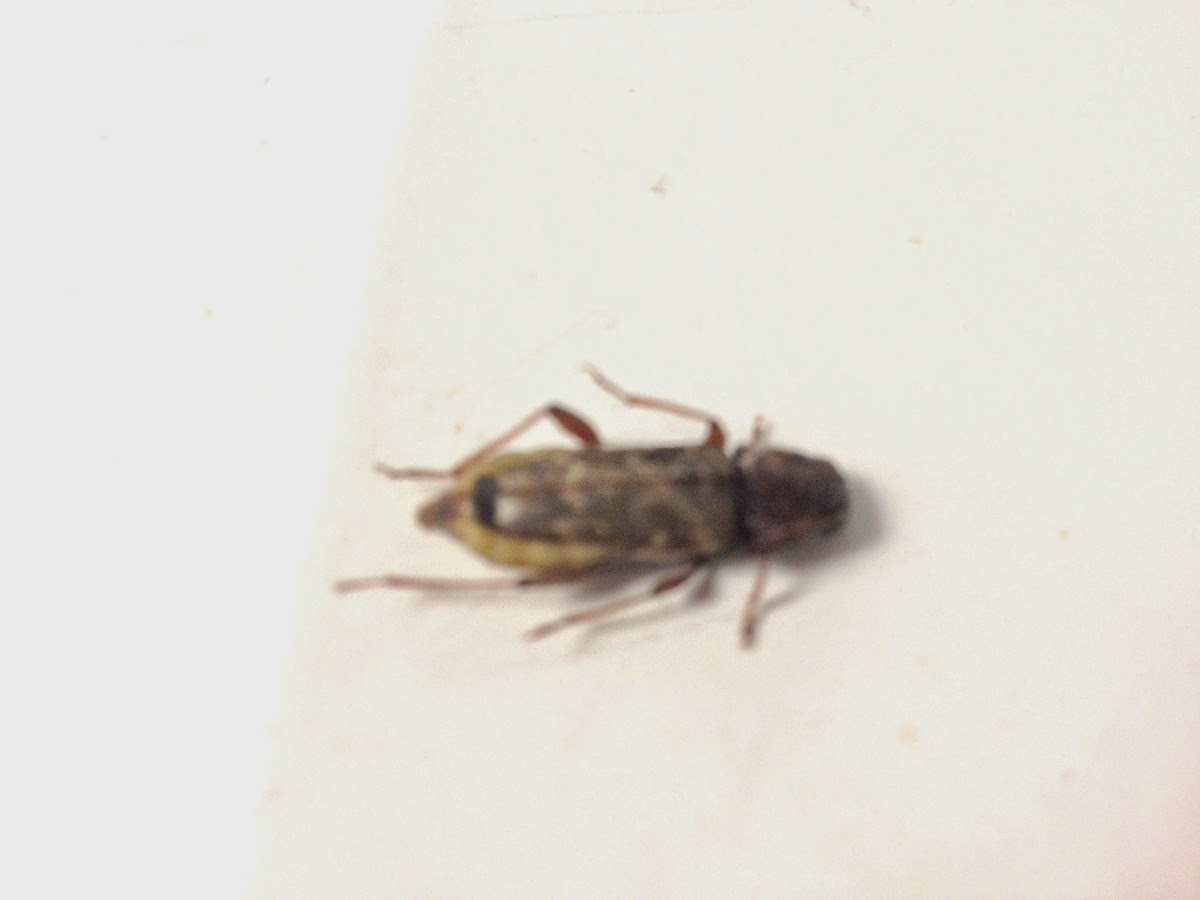
 The below beetle and larvae was brought into my office to find out if it was the cause of death of live oak (Quercus agrifolia) here in Arcadia. Turns out this little bugger, called a Nautical borer, chows down on dying and dead oaks but is not responsible for the initial demise of the tree.

Nautical beetle.

Nautical beetle larvae
 What is most probably the cause of the trees demise was evidenced by signs of another, more insidious beetle on an oak tree located nearby. Both branches and trunk of the tree showed the exudate and white sawdust halo of the Polyphagous Shot Hole Borer (PSHB), a fairly new pest that is decimating trees in the area. 
Oak tree branch showing the soaking spot with small sawdust halo inside that is the hallmark of the Polyphagous Shot Hole Borer(PSHB). 

Soaking area on oak tree -a sign of PSHB. 
More on the Nautical borer can be found here: A Field Guide to Insects and Diseases of California Oaks
More on the Polyphagous Shot Hole Borer can be found here:  http://ucanr.edu/sites/socaloakpests/Polyphagous_Shot_Hole_Borer/

Sunflower Leaf Problems

I got the below sunflower leaf from a patron who was worried about weather these symptoms were a death sentence for the sunflower they were found on. This is the sunflower leaf miner, and like most leaf-miners it can be controlled by removing the infested leaves from the plant and cleaning the fallen ones out from underneath the plant. Chemical control is really not necessary unless you are entering the entire plant in a contest and the prize is over $10,000. One good way of keeping damage levels down (besides the above) is to keep fertilization to a minimum. High levels of nitrogen not only make the leaf soft and easy to feed on, but directly feed the leaf-miner with a nutrient that lack of otherwise limits its growth and reproduction. 
Sunflower leaf miner
Posted by Picasa

Tuesday, July 30, 2013

Columbia London Plane Tree Planted in Temple City

 I was rolling north on Rosemead boulevard and I had to stop the car and take a picture. Why? Because I thought a tree that I really like was being used in a street planting there in Temple City -the Mexican sycamore.  A real good choice by city landscape architects in my opinion; turns out however it was Platanus x acerifolia (Air.) Willd. 'Columbia' planted along side Rosemead blvd. Still a good choice, these hearty trees are more upright, less prone to leaf  problems, and don't drop as many leaves as their native California cousins. It's really nice to see such choice of tree being used on city streets. I can't wait till these  beauties reach their 50 foot maximum height. (Note: I had originally identified the tree as a Mexican sycamore -but found out that it was Platanus 'Columbia' when the city returned my call).


Posted by Picasa

Followers