Showing posts with label Quercus agrifolia. Show all posts

Thursday, January 31, 2019

A Killer Lurks Below

The Delonix tree above fell over during the rainstorms earlier this month. The culprit?
The culprit is plainly visible looking at the crown of the tree. Notice the whitish almost tan growth on the edge of the broken crown of the tree. That is most probably Armillaria mellea, the honey fungus, whose large clusters of mushroom fruiting bodies are visible throughout the Arboretum after the first, soaking cold rain of the season.
Armillaria fungus on the underground portion of the crown. 
Below you can see the fruiting bodies (mushrooms) of the Armillaria fungus pushing up near a Brachychiton tree in the Australian section. 
Armillaria mushrooms fruiting in the Australia section. 
Besides 'Honey Mushroom' the other common name for this fungus is the 'Oak Root' fungus. It can be found in areas that have or have previously had native oak trees. Most of the Arboretum was, in the past, oak woodland. Two species, Quercus engelmannii the Engelmann or 'Pasadena' oak and Quercus agrifolia, the Coast live oak dominated the landscape here.

Indeed, the Honey fungus seems to have an almost symbiotic relationship with the Coast live oak and the Engelmann oak. Healthy trees seem to thrive despite being infested with the fungus. Indeed the oaks and the fungus might have what you might call a semi-beneficial relationship. The fungus destroys woody trees and shrubs that might compete with the oak, and the oak might even provide water and minimal nutrition for the fungus. In fact, it has been shown that an Armillaria fungus has a symbiotic relationship with the Chinese medicinal orchid Gastrodia elata and has been reported as having a mycorrhizal relationship with at least two oak species. 

Although the oaks relationship with the fungus may be beneficial at times, if an oak tree is under any kind of stress (especially soil compaction and over-watering during its dormant period in the late summer) the fungus will aggressively go after the tree, sometimes killing it in one to three weeks time. 

So how to deal with this underground killer? Unfortunately there is no chemical method of control. The main method of control is watering your landscape correctly to prevent activating the fungus (in particular by encouraging water loving organisms like the root rotting Phytophthora fungus that damage plant roots, in turn causing them to attract Armillaria that is present) and removing any large pieces of wood that are 2" or more in diameter that may be buried in the ground.

Wednesday, May 25, 2016

Live Oak Pruning Problems

Q. When is the proper time of year to trim a Coast Live Oak tree? And,is a permit required? My neighbor is having his tree trimmed today, May 14 and I'm concerned about the tree. Lisa

A. Sorry I wasn't able to get back to you before the tree was trimmed. What is the situation? Exactly where is the oak in question? As far as trimming, generally you should only trim live oaks if it is absolutely necessary, otherwise you’re just damaging their chances of surviving. What town do you live in? Could you send me a picture of the tree as it was and as it is now?

Q. Hi Frank, Thanks for getting back to me.  Sorry, I don't have pictures to forward, but I can tell you that the tree in question is a huge, old tree which has been here for all the 43 years we've lived in our E. Pasadena home.  The tree can be seen from the corner, where it is located in the backyard of that house.  It has been severely trimmed, in my estimation and according to the trimmers, they had a permit.  I'm just hoping it will survive.  Thanks for your input.  Lisa

A. You might want to mention to the owners that:

1.       The main thing keeping any tree up is its own weight acting through the force of friction. The heavier the tree the more likely it is to stand up to storms and winds.
2.       The fine structure of oaks and other trees helps dissipate the winds force on them, leading to greater stability and less chance of failure.
3.       Trimming a tree degrades the above two factors and causes a tree to be MORE likely to fail.
4.       Tree canopy density is proportional to the amount of nutrients a tree receives via photosynthesis (it has no other way to make energy), so when you trim your trees you starve them as well.
5.       The new growth that trees put on after trimming relies mostly on their stored food reserves –it further robs the trees of nutrition and puts them in danger of disease, insect infestations and ultimately, failure.


Q. Hi Frank, Thanks so much for the info...wish more people knew that!  I'm sharing w/ folks I know.  One Q. about Coast Live Oak trimming remains: Is there a correct season for trimming them?  Regards, Lisa
A. Yes, live oak trees, like Quercus agrifolia the California live oak, are best pruned when dormant in the late summer and early fall.

Resources:
  1. Living Among the Oaks: This University of California Agriculture and Natural Resources booklet describes the special needs of California native oaks. A must read if you have an oak tree. Many people are killing their oak trees with kindness and the landscaping they have surrounding the trees -this pamphlet tells you if you are doing just that. 
  2. Pruning California Live Oaks: Published by the Ventura County Agricultural Extension. Goes over the how when where and why of pruning oak trees (no surprise; states that the best pruning is often no pruning at all). 


Thursday, August 1, 2013

Bugs and Fungus Come Into My Office

Mushrooms

These were brought in by a woman who was worried about mushrooms poisoning her dog. Previously she had brought in some Conocybe mushrooms that were poisonous but may or may not have been responsible for her dog getting sick (they are known to contain toxins like the ones in the 'Death Cap' mushrooms but the chemistry of the ones in the Conocybe is such that they have to be absorbed directly into the bloodstream to be harmfull). These turned out to be Collybia fuscopurperea (also called Gymnopis villosypes) an indedible but not known to be poisonous mushroom that is classed by many as a 'LBM' (a 'little brown mushroom' so minute and inedible that its toxicity is inconsequential),


Collybia fuscopurperea


A Beetle Responsible for the Death of An Oak Tree?

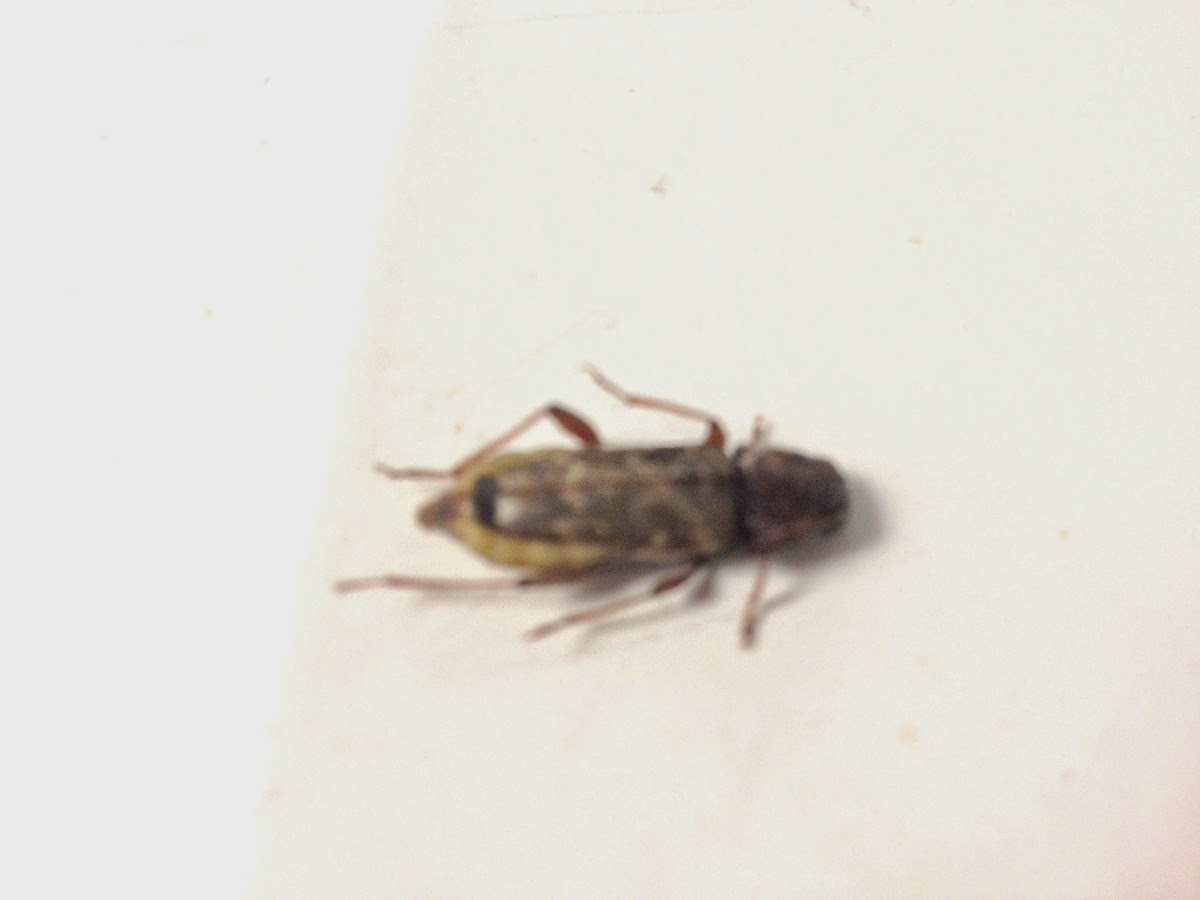
 The below beetle and larvae was brought into my office to find out if it was the cause of death of live oak (Quercus agrifolia) here in Arcadia. Turns out this little bugger, called a Nautical borer, chows down on dying and dead oaks but is not responsible for the initial demise of the tree.

Nautical beetle.

Nautical beetle larvae
 What is most probably the cause of the trees demise was evidenced by signs of another, more insidious beetle on an oak tree located nearby. Both branches and trunk of the tree showed the exudate and white sawdust halo of the Polyphagous Shot Hole Borer (PSHB), a fairly new pest that is decimating trees in the area. 
Oak tree branch showing the soaking spot with small sawdust halo inside that is the hallmark of the Polyphagous Shot Hole Borer(PSHB). 

Soaking area on oak tree -a sign of PSHB. 
More on the Nautical borer can be found here: A Field Guide to Insects and Diseases of California Oaks
More on the Polyphagous Shot Hole Borer can be found here:  http://ucanr.edu/sites/socaloakpests/Polyphagous_Shot_Hole_Borer/

Sunflower Leaf Problems

I got the below sunflower leaf from a patron who was worried about weather these symptoms were a death sentence for the sunflower they were found on. This is the sunflower leaf miner, and like most leaf-miners it can be controlled by removing the infested leaves from the plant and cleaning the fallen ones out from underneath the plant. Chemical control is really not necessary unless you are entering the entire plant in a contest and the prize is over $10,000. One good way of keeping damage levels down (besides the above) is to keep fertilization to a minimum. High levels of nitrogen not only make the leaf soft and easy to feed on, but directly feed the leaf-miner with a nutrient that lack of otherwise limits its growth and reproduction. 
Sunflower leaf miner
Posted by Picasa

Followers