Saturday, January 21, 2017

South Pasadena Ailing Avocado


Area underneath Avocado tree. 

South Pasadena Ailing Avocado


Q. I live in South Pasadena and we have an avocado tree that is more than 50 years old that appears to be dying. The canopy has shrunk significantly, the leaves have brown edges and are falling and there are a lot of dead branches. In addition, the tree is producing less and less fruit each year.  

We've tried to increase watering the tree, but it does not appear to be helping. Any recommendations to help save our tree?

A. You actually have a very lucky tree; the conditions I see in the photo are not the best for avocados.

The area underneath an avocado tree should be free and clear of lawn and high amounts of soil compacting human activity. Also, the best thing to have underneath an avocado tree’s canopy is a thick carpet of its own fallen leaves.

The avocado’s leaves decay to from a substrate that is perfect for those organisms and microorganisms, insects, worms, protozoa, bacteria, fungi, nematodes etc. which are beneficial to the avocado. Add to that the fact compacted soil tends to be devoid of these organisms and the amount of water that the lawn underneath the tree needs to keep it green is an ideal breeding ground for a type of fungi-like organism (Phytophthora) that eats avocado roots for dinner, and you have the perfect recipe for the slow but sure demise of your tree.

Also, the drought has probably caused considerable salt buildup underneath the root zone of the tree. Fortunately, these recent rains should take care of that.

So what to do? Remove all lawn from underneath the canopy of the tree (on both sides of the fence if possible). Apply horticultural gypsum to the soil at the rate of about 25 pounds scattered throughout the area underneath the canopy, then lay down a 5-inch-thick layer of shredded (if you don’t have squirrels or rats, they love the shredded stuff) or small sized (this one’s the best) fir bark underneath the entire area underneath the canopy of the tree except for an are 4-5 inches from the trunk (you don’t want the fir bark piled up against the trunk, that can cause a condition where the tree’s bark becomes infested with insects and fungus owing to the humidity raising and fungal spore nurturing nature of the fir bark). Also Then allow the avocado’s soil nurturing leaves to remain where they fall in Perpetua.

Do not feed your avocado much; high nitrogen levels in the leaves and tissues favor pest infestation. Use about ½ strength Avocado/Citrus food just once a year (in November -it’s too late now). If you have a problem with leaves falling off after this, it is most probably Persea mite. This pest is mostly a nuisance but during the drought has become more than that, causing total defoliation in some cases. It can be controlled using horticultural oil and cultural management.

Please let me know how these measures are working or not in about six months’ time. 

Wednesday, January 11, 2017

Shade Plants for Drier Gardens

Although nothing grows is complete darkness (plants will etiolate, or weirdly stretch though) except for some parasitic plants, these plants will hold their own in many shade cursed areas in your garden. 

Aspidistra elatior

Commonly called the "Cast Iron Plant" for good reason; this slow growing but hardy Taiwanese native can take all kinds of abuse including abysmal light levels and infrequent watering (once established). 

Liriope 


Pronounced like 'calliope', this Chinese native thrives in bright shade to partial sun and moderate water -but will survive a moderate dry spell no worse for the wear after it has been established for at least a year or two. In part sun you can expect them to flower with either white or blue spiky blooms, but if they are planted in mostly shade, then they probably will not. 

 Mondo Grass

Ophiopogon japonica, commonly called 'Mondo Grass',i s a lily-like ground-cover that looks kind of like grass if you like lumpy lawns. It is, however, a good ground cover plant for shady areas and, once established (a process which can take some time), can tolerate short to moderate periods of drought. Pictured above are standard sized and dwarf Ophiopogon japanica. 

 Nandina

Nandina, a dwarf variety, growing in the shady part of the entrance walk at the Arboretum. 
Full sized Nandina kicking it on the shady north side of a wall. 
Nandina, commonly called 'Heavenly Bamboo', is an ubiquitous element of many Southern California gardens for a good reason; it is incredibly tolerant of low light, low water and low maintenance. Also a Chinese native (are you noticing a trend here?), some people worry about the toxicity of its berries to cats and Cedar Wax Wings -however in low light it tends not to produce as many (if any) berries as in full to half day sun. 

Clivia

Clivia

Clivia

Clivia x cyrtanthiflora
Hailing from the Southern parts of Africa, this strap leaved, winter and spring flowering plant is tough. Although it does enjoy water when it's blooming, when it's not it can go two weeks or more between watering. There are several different varieties including one with a yellow flower. Sometimes you will plant Clivia and it has a hard time blooming. The secret is to plant them in bottomless pots or very close (less than a foot) from each other. For some reason being crowded seems to induce more bloom. 

Asparagus


Asparagus densiflorus 'meyerii'. 
Not the one you eat but the ornamental kinds like A. densiflorus 'meyerii' and A. aethiopicus (syn. sprengeri). Once established these hardy plants may be hard to control, just remember that they can spread via bulbs that they copiously produce underground. 

 Abutilon

Once established these Hibiscus family members with the unfortunately misleading common name of "Chinese Maple" are extremely hardy in some fairly shaded areas once they are established (this I know from personal experience -I had one in a completely shaded area of a house I once had and it would not die no matter how badly I ignored it).  It comes in low growing and somewhat vine-like bushy varieties, the latter which have proved themselves survivors. 

Mahonia


Mahonia oiwakens subsp. lomariifolia

Mahonia repens
This group of hardy shade loving plants is native to the west coast of the United States and Asia and is one of the few plants to produce yellow flowers in the shade. Mahonia repens is a low growing ground-cover whereas Mahonia oiwakens subsp. lomariifolia is tall (up to 6-7 feet) and beautifully lanky. 

Carissa


Variegated Carrisa

Dwarf and standard C. macrocarpa
This African native not only is an excellent dry area part shade to bright full shade ornamental, its ripe berries are edible! Several varieties are available including a dwarf and variegated type. What's the drawback to its seeming perfection? It is somewhat frost tender, and can experience considerable (though recoverable) die-back in cold years. 

Amaryllis and Amaryllis Hybrids 

Amarygia hybrids, a cross between Brunsvigia and Amaryllis. 
 Commonly called 'Naked Ladies', these South African bulbs produce beautiful pink blooms on stalks with no foliage in the hottest part of the summer, usually mid to late August. They will reliably bloom in bright shade, filtered sun, or even half day to full sun.

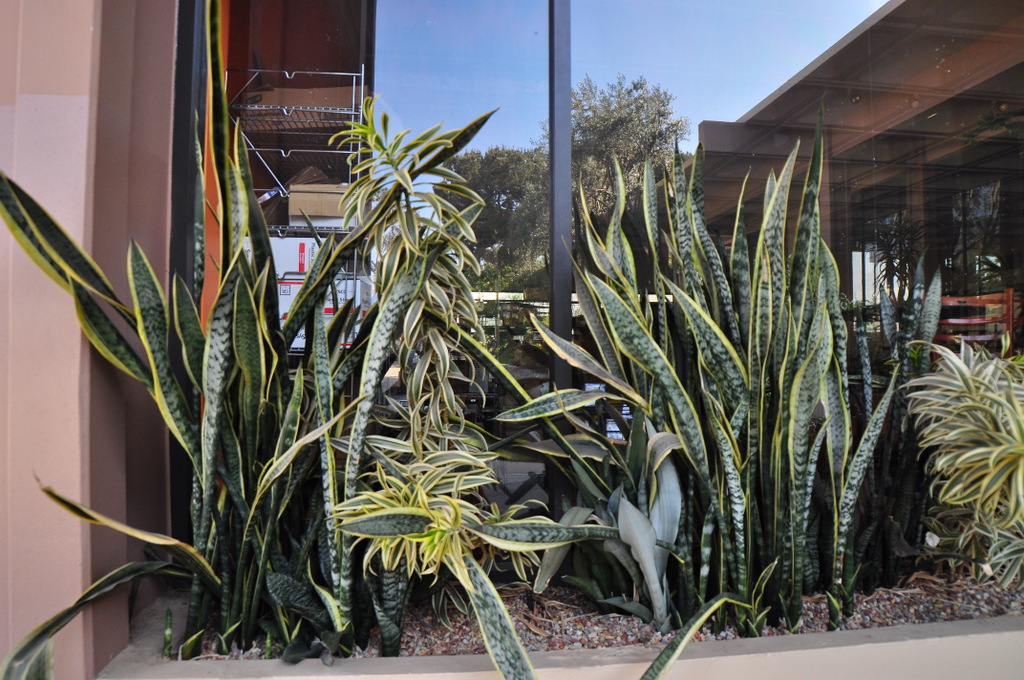
Sansavieria

Various species and varieties of Sansavieria. 
Ultimately hardy, these African natives thrive on neglect -just don't water them too much. They grow in half day to full sun, but will gracefully tolerate (and even thrive) in filtered sun to bright shade.

Tuesday, December 20, 2016

Assassin's Creed

Assassin Bug (Nymph)


Just in time for the release of the "Assasin's Creed" movie I received this picture of a bug to identify. Turns out it is not only a 'bug', but a true bug, a member of the order Hemiptera, a large order of piercing sucking insects that includes aphids and bed bugs. This one is a little more welcome than the previously mentioned bugs: it's a predator of aphids and other harmful insects.

Thursday, December 15, 2016

Jawdropping Fall Color at the Arboretum

There, I've used a Buzzfeed keyword; it is well deserved however. Right now we're probably looking at the last gasp of really spectacular fall color until next year; this is because the heavy rain predicted for this evening may just well knock off most of the fall foliage that is currently peaking here at the Arboretum.
A species Liquidambar near the Peacock cafe. 

Crepe myrtle in full color near the Peacock Cafe. 

Aloes starting to bloom in the South African section. 


Crepe myrtle (right) and Persian ironwood (left)

Persian ironwood. 

Wild wisteria vine growing on trees on the north edge of the Tropical forest section. 

Wild wisteria and wild grape vines clambering on foliage on the north side of the Tropical forest. 

Pink Handroanthus paulensis blooms (right) surrounded by white Shaving brush tree blooms. 

Pink Handroanthus paulensis  and white Pseudobombax ellipticum blooms on the east shore of the Baldwin lagoon. 

Ginkgo biloba tree framing Cycads. 

Ginkgo biloba tree framing Cycads. 

Friday, November 18, 2016

Another species of Varroa mite threatens European honeybees (from Science Daily)

(Please keep in mind that science journalism has become a little more sensationalized than it once was)


From Science Daily:


  Another species of Varroa mite threatens European honeybees: A sister species of the Varroa destructor mite is developing the ability to parasitize European honeybees, threatening pollinators already hard pressed by pesticides, nutritional deficiencies and disease, a study says.

Wednesday, November 9, 2016

A Not So Great Crepe Myrtle

Question:

Thank you for your time.  I purchased a crape myrtle last summer and it did well for a few months.  During dormancy I did not water it very much and this spring it really looked puny.
 I was told by a neighbor that has healthy nice crape myrtles that it needed a lot more water than I was giving it;  30 gallons a week during dormancy and up to 60 gallons per week during the summer months.
 My tree originally came in a 42 inch box and is now about 18-20 feet high.

Thank You, Maria

Hi Maria,
Could you answer some questions for me?
              1.      Has the tree progressed much at all from the size they were in the box?
2.      Did you fertilize the tree when you planted it? If so, with what?
3.      What was the average temperature for the next several weeks after you planted it (roughly)?
4.      When you dug out the hole for the box, did you dig it deeper than the depth of the box?
5.      What kind of amendment (if any) did you use in the hole? What percentage soil and what percentage amendment?

Cheers,   Frank

Hi Frank,
 I can answer some of the questions but not all.  I purchased the tree from --------,  and they dug the hole amended the soil and fertilized my tree.
 I of course watched and the hole was at least the depth of the box if not more so.
They gave me a liquid fertilizer to use once a month and I have added worm castings periodically.
 She was my 60th birthday present to myself and I hate to think that she isn't thriving and as beautiful as she should be.  I will say that she did flower beautifully for about a month this summer but she isn't very full as far as leaves go.
Thank you for your patience and help.

Maria

Hi Maria,

 Amending the soil is not recommended when you plant a crepe myrtle. Also, fertilizing any tree when it’s planted can be harmful to the tree. The fertilizer can cause a condition where the fertilizer salts burn the roots, causing them to form a type of scar tissue that can dwarf the tree and stunt its growth for the rest of its life.
Also, the ideal size to start a crepe myrtle out (or any tree for that matter) is a five gallon or smaller container. The larger the container, the more of a possibility the plant is going to be root bound and do poorly, plants in smaller containers naturally establish better than ones in larger containers.
The once a month fertilizing is way too much for the plant. Most ornamental trees and shrubs should only be fertilized once in their lifetimes, usually between 9 months and 1 year after they are established.

Cheers,   Frank


Hi Frank,

Okay thank you then I will stop fertilizing her. What do you think about the water amount and also do I water at all during dormancy?

Maria

Hi Maria,

Create a watering basin around your tree (see item number 4 on this link) –fill it with water by hand every week until the rains come.  Start watering again in the mid to late spring.

Cheers,   Frank


Saturday, October 22, 2016

Low Carbon Footprint Trees Links


Low Carbon Footprint Trees Talk Links:


Carbon dioxide emission footprint calculator and offset estimator
Formula calculates how much water each tree needs - Midland Reporter-Telegram
Hw much to water trees: SN900A_How-Much-Water.pdf
Irrigating Citrus Trees: az1151.pdf
Orchard-LCA-Fact-Sheet.pdf
Coast Live Oak Care and Management: cs_quag.pdf
UFEI - SelecTree: A Tree Selection Guide
Pacific Horticulture Society | The Most Majestic Southern California Oak
Oaks And Carbon Sequestration
UFEI - SelecTree: A Tree Selection Guide Quercus engelmannii
Mexican White Oak Growth Rate | Home Guides | SF Gate
Global Species : Quercus polymorpha (Mexican White Oak)
Article about carbon storing trees -most of these are terrible for Southern California: Eartheasy Blog » 10 Carbon-Storing Trees, and How to Plant Them
CarbonFootprintof of Water-RiverNetwork-2009.pdf
Impacts of Urban Water Conservation Strategies on Energy, Greenhouse Gas Emissions, and Health: Making the case for recycled water: Southern California as a Case Study
Despite their huge psychological benefits, lawns are terrible wasters of water and producers of CO2 according to this article: Urban parks: a global warming downer? | Greenspace | Los Angeles Times
El Paso's favorite trees here: Texas Tree Facts
Find out what your Carbon Footprint is: CoolClimate Calculator

Englemann Oaks


Planting Engelmann Oaks
Our own senior biologist, Dr. Jim Henrich, tells us why Engelmann oaks are one of his favorites: Engelmann oaks, better than beautiful | L.A. at Home | Los Angeles Times

Saturday, October 15, 2016

Links For Hipster Horticulture: Botany Boot Camp

Orchidaceae


Myrtaceae


Asphodelaceae

Lamiaceae

Asteraceae

Agavaceae


Fagaceae


Poaceae

Bignoniaceae


Followers